




AI Shopping Agents: How to Get Your PrestaShop Store Recommended by AI


AI shopping agents are starting to pick products on behalf of shoppers, and that changes the rules of e-commerce. Here’s an example. A shopper asks her AI assistant: “Find me a desk lamp under $50 with warm light that can arrive before Friday.” The assistant scans a dozen stores, compares specs and comes back with three picks. Your store isn’t one of them, even though you carry the perfect lamp at a great price. Why? The agent couldn’t find the color temperature in your data, and the stock level in your feed was two days old.
Welcome to agentic commerce, where shoppers hand the buying over to AI. A year ago it sounded like a conference buzzword. Today the biggest platforms are reporting real numbers, and with Black Friday around the corner, it’s worth checking whether agents can actually read your store.
The short version: AI agents don’t look at banners. They read data. The winners are stores with complete product attributes, clean structured data, up-to-date prices and stock, and clear return policies. Most of that work also boosts regular SEO and conversion, so you’re not investing in some distant future.
What changed in fall 2026?
In early November, Shopify reported that orders coming from AI search were up 3.3x year over year in Q3. The company noted the base is still small, but added two telling details. AI channels send shoppers to product pages three times as often as organic search, and roughly three quarters of AI-referred sales came from categories outside the top 100.
In Europe, Zalando unveiled its first AI shopping agent and said agents will be able to check out on a customer’s behalf in 2027. Payments are shifting too. Mastercard announced a strategic partnership with OpenAI, while Google, Visa and payment providers are building setups where an agent gets limited permission to pay and never sees the card number. Mastercard’s CEO was candid, though: it’s still early days, and the numbers aren’t significant yet in the grand scheme of things.
How do AI shopping agents pick a store?
Think of an agent as a very demanding but impatient customer. It doesn’t scroll, it ignores pop-ups and it skips the slogans. It pulls the data, matches it against the user’s request and drops anything that looks uncertain. If the price on the page doesn’t match the price in the feed, or availability is unclear, recommending a competitor is the safer bet.
The industry is turning this into open standards. The ones you’ll hear about most are Google’s Universal Commerce Protocol (UCP), launched in January 2026 with partners including Shopify, Walmart and Etsy; the Agentic Commerce Protocol (ACP) from OpenAI and Stripe; and MCP, which lets agents read data such as stock levels and prices. For a PrestaShop merchant the takeaway is simple: before polished modules exist for every standard, what matters is the quality of the data you already publish. The graphic below sums up six requirements.
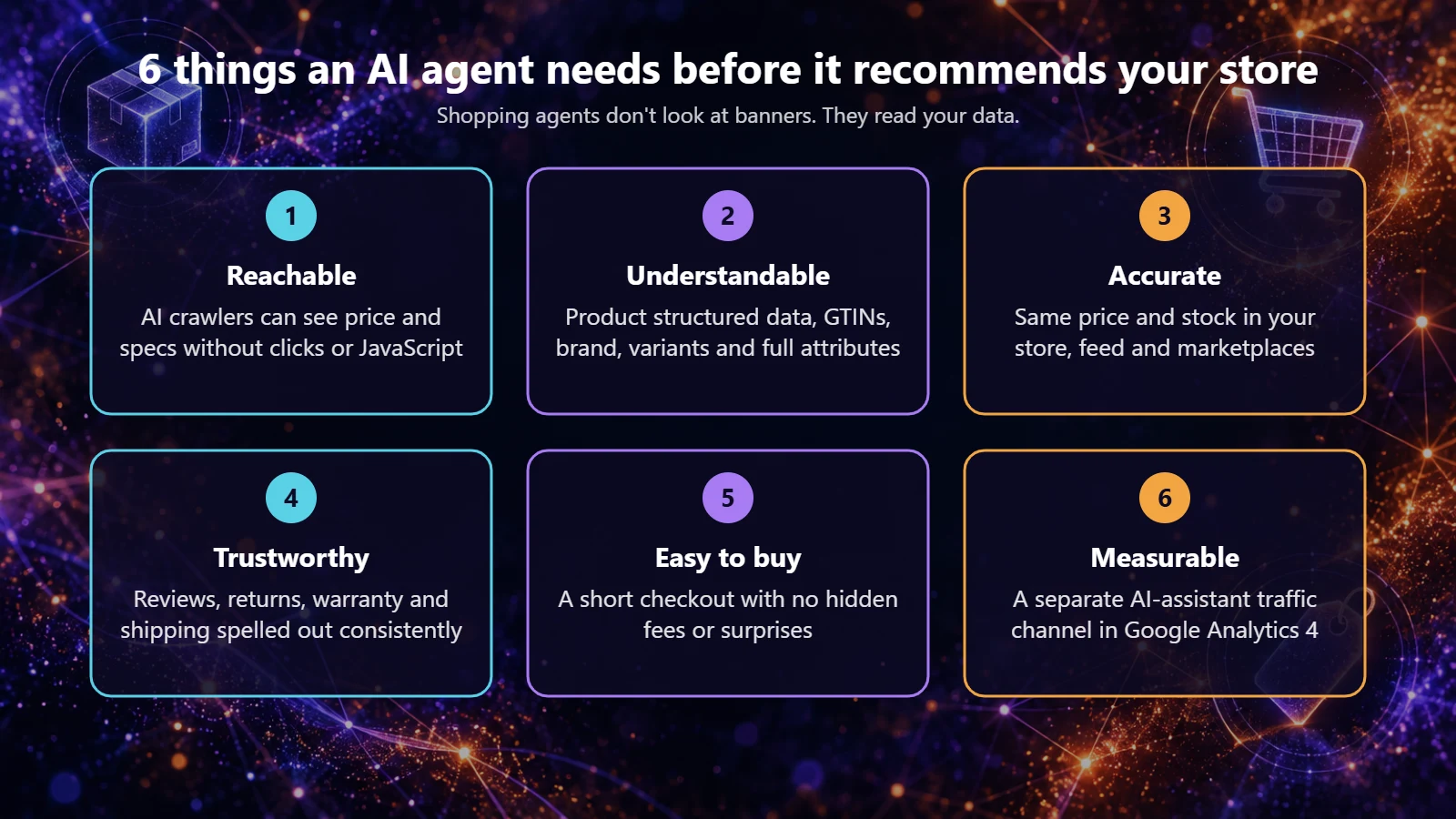
Six steps to get an AI agent to recommend your store
Sound familiar? Most of this is simply good e-commerce practice. The difference is that a human will forgive a missing spec and ask in live chat. An agent won’t. It just moves on to the next store.
What does this mean for a PrestaShop store?
Product data. Many stores bury key details in the description instead of product features. To a shopper it makes no difference; to an agent it’s huge. Move the specs people actually ask about (dimensions, material, compatibility, color, wattage) into features and fill in the GTINs. Your filters and on-site search will thank you too.
Structured data. Run your product pages through Google’s Rich Results Test and see what’s really in the code. A common issue: the theme outputs markup without variant availability and price, or two modules duplicate it with different values. The agent then sees conflicting information.
Feed and sync. If you also sell on marketplaces (for example through a PrestaShop and Base integration) or run an ERP, make sure each product has the same identifier and price everywhere. Duplicates with different part numbers and no shared GTIN signal uncertainty to AI.
PrestaShop 9.2. Released at the end of September, it brings a native One Page Checkout, the Ask AI back-office assistant (in the PrestaShop Classic edition) that answers questions about your store data in plain language, and Extra Properties, an easy way to add custom fields to products and other entities. That last one in particular makes it easier to structure the data agents look for. Before upgrading, check compatibility with your theme and your payment and shipping modules.
The ECOMPLUS+ team
How can you tell if AI already recommends your store?
Fun fact: AI sells beyond the top 100 too
The most surprising takeaway from Shopify’s numbers is about the long tail. Traditional search and ads favor popular products because that’s where most of the signals are. An AI agent matches products to a very specific need, so niche items get a real shot, as long as they’re well described. For stores with specialized catalogs, that’s great news. For stores relying on short manufacturer blurbs, it’s more of a warning.
Bottom line
Shopping agents won’t replace regular customers this season, but they already decide who makes the shortlist. Start with fixes that pay off twice: structured product attributes, clean structured data, a fresh feed and a straightforward checkout. You’ll improve SEO, filters and conversion, and get your store ready for AI-assisted shopping along the way.
Want to see how your PrestaShop store looks to an AI agent? Get in touch. We’ll review your product data, markup and feed and point out the fixes that will make the biggest difference.
FAQ
Are AI agents already buying from online stores?
Fully agent-completed purchases are still rare and mostly limited to select markets. But product recommendations and comparisons in AI assistants already work in many languages and are sending traffic to stores today.
Do I need to implement UCP or ACP?
Not yet. The standards are still evolving. Get your data and feed in shape first, since every one of them depends on that.
Does blocking AI bots protect my store?
It protects your content, but it can also mean assistants won’t know what you sell. Make a deliberate call, ideally separately for bots that train models and bots that fetch information for users.
Is this worth it for a small store?
Yes. Most of the changes are data cleanup that also improves SEO and filters. It takes consistency, not a big budget.